
TVM 2$days
TVM Tuesdays is a weekly blog that offers a fun, new take on this age-old topic and financial education insights from Brent Pritchard.
Sign up for email notifications:

Who (You Know) Is on First.
In addition to helping aspiring finance professionals grasp the concept of the Time Value of Money like the backs of their hands, I also coach finance students. The other day, I was talking with an individual about their job-search process. It was from that conversation that this week’s blog post was inspired.
If you’re in any field long enough, it’s almost inevitable that you will have a manager (or a manager’s manager) who is batshit crazy. Such is life. But that’s not a reason to get discouraged. People are people. Some are (in fact) crazy. Others might simply be conflicted with your personality.
“The game must go on,” were wise words from Franklin Roosevelt who was referring to a desire to keep professional baseball going during World War II. This quote provides general inspiration for trials you will no doubt encounter in your professional life.
The game of baseball, in particular, provides a metaphor for the job-search process and an easy way to see where, if at all, you are off base and in what areas you might improve your efforts. As you study the baseball illustration that follows, it will help to keep the following things in mind:
You can’t get to second base without first touching first base, and so on and so forth.
It only takes one connection between bat and ball for a batter to become a baserunner—but there is such a thing as a pinch runner if you’re not the best at making connections.
A professional is within “scoring position” at second base—with a resume that tells your professional story and speaks to your marketable skills as well as your unique value proposition (between its bullet point lines).
The “Hot Corner” as it’s known must be rounded to reach home plate—just as prospective employers require that you complete an application.
Leading off the bases is not required—but things like: 1) relevant experience makes a resume better; 2) a cover letter makes an application better; and 3) interviewing skills improve your chances of getting an offer and making your job search a home run.

What you know is more important than the Who you know…who’s on first…?
Brent Pritchard is an author and college finance lecturer with over two decades of industry experience and cofounder of Boxholm Press, LLC, a family-owned-and-operated publishing company providing educational content, products, and services. He pioneers an innovative and approachable new way of learning and teaching the Time Value of Money as well as thought leadership in other business topics. His most recent book is Would Your Boomerang Return? You can contact him on his website here.
When Is “in Decision” a Good Thing in Finance?
As a parent who is helping a child through college (in part because she recognizes higher education as her investment, not mine), there’s one surefire way to tell if you got more out of what you paid for your finance education.
Here’s an excerpt from my book Would Your Boomerang Return? What Birds, Hurdlers, and Boomerangs Can Teach Us About the Time Value of Money (2023):
My Time Value of Money lesson has always been the one that packs the biggest punch, both in terms of important information and unfortunately knocking down some students’ self-confidence. In addition to being foundational to finance, historically this lesson was also the one that left some of my students with the deer-in-the-headlights look, made some students jittery in their seats, and in some cases put students on the border of becoming fighting mad.
Now if there’s one building block Time Value of Money equation that punches above its weight, this is it:
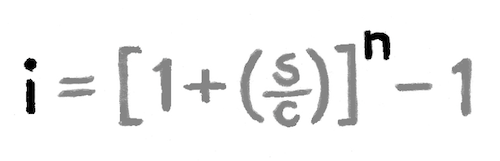
Illustration by Scott Alberts. Copyright 2022 Brent Pritchard. All rights reserved.
Some might recognize the dot of the “i” as the snowball of compound interest.
When do you remember learning about the building block True Investment Yield equation?
Brent Pritchard is an author and college finance lecturer with over two decades of industry experience and cofounder of Boxholm Press, LLC, a family-owned-and-operated publishing company providing educational content, products, and services. He pioneers an innovative and approachable new way of learning and teaching the Time Value of Money as well as thought leadership in other business topics. His most recent book is Would Your Boomerang Return? You can contact him on his website here.
Dogs Think This Book Is Too Good to Eat!
I don’t think it’s a coincidence that dog is God spelled backward. The love of a dog is close to, if not, perfect. While dogs may not be all-knowing, they are very smart (and they know a good book when they see one, which might explain why they eat people’s homework if they want their people to also feed their brains):
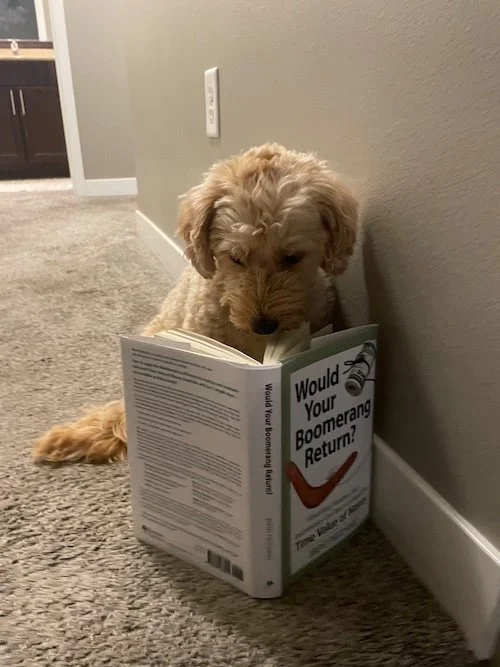
Photo by Brent Pritchard.
Do you like to receive and read letters? Have you ever thought about the fact that the most popular salutation is spelled with the same letters that describe what you’ve been asked to do?!
Here’s an excerpt from my book Would Your Boomerang Return? What Birds, Hurdlers, and Boomerangs Can Teach Us About the Time Value of Money (2023):
Here is something that is not openly acknowledged or talked about that often: LTV is overrated. The LTV metric doesn’t consider the Cap Rate (CR). Unfortunately, we can’t combine these two acronyms to form a word that will help you remember to avoid this pitfall without “buying” a few vowels. By adding “Y” and “E” and “O” to the mix, we can spell “covertly,” which speaks to how deceptive LTV has been for so many people over the years. Let’s not repeat this history. Be a yeoman and remember that Debt Yield (DY) is a better metric from the lender’s perspective, since it considers the amount of mortgage capital and thus is the approximate cap rate that would lead to the return of investment.
This text is from Chapter 3, which is where I weave in some knowledge from my days as a real estate professional to help bring the topic to life for the reader.
What investment metric didn’t seem to exist prior to the Great Recession that everyone (and their dog) was saying after? (Hint: It’s not LTV or CR.)
Brent Pritchard is an author and college finance educator with over two decades of industry experience and cofounder of Boxholm Press, LLC, a family-owned-and-operated publishing company providing educational content, products, and services. He pioneers an innovative and approachable new way of learning and teaching the Time Value of Money as well as thought leadership in other business topics. His most recent book is Would Your Boomerang Return? You can contact him on his website here.
Get the Book Today!

Would Your Boomerang Return? provides a fun, new take on how the Mathematics of Finance is learned and taught:
All-in-one resource: all the important information on this all-important topic in one place with chapters in the What and How sections that double as individual lessons
Ease of reference: includes the first-of-its-kind user manual for the Mathematics of Finance with chapters named after sections typically found in an actual user manual for quick look up
Simple and definitive tool: 3-Step Systematic Approach for analyzing and evaluating real-world Time Value of Money situations
Decision-making framework: 23 real-world Time Value of Money questions, space to work out answers, and a "baseball count" system to evaluate understanding of the different types of questions
An easy read: complete with sprinklings of real-life stories and maybe even an ounce of inspiration here and there
Sign up for TVM 2$days, a weekly blog that offers a fun, new take on this age-old topic and financial education insights from Brent Pritchard.