
TVM 2$days
TVM Tuesdays is a weekly blog that offers a fun, new take on this age-old topic and financial education insights from Brent Pritchard.
Sign up for email notifications:

For Finance Professionals Interpreting Inputs Is Key.
The most popular question in a classroom might be, “Will this be on the test?” A close second in a finance class just might be, “Can we use Excel on the exam?”
But what good is Excel if an aspiring finance professional can’t interpret the five primary TVM (financial calculator) inputs? This is where one needs more than one acronym to describe the variable. Enter the colon:
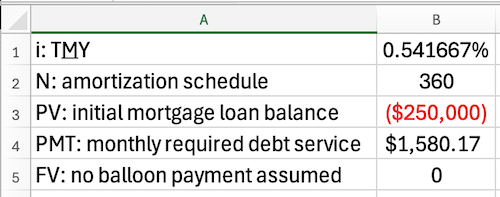
Photo by Brent Pritchard.
Here’s an excerpt from my book Would Your Boomerang Return? What Birds, Hurdlers, and Boomerangs Can Teach Us About the Time Value of Money (2023):
I feel the need to let you know that I’m not anti-spreadsheet; however, I’m a big proponent of using financial calculators and longhand math, as needed, to analyze and evaluate real-world Time Value of Money situations.
It always makes me laugh when one of my students—even if the student has experience in the industry—tries to tell me that financial calculators are rarely used anymore. Are you kidding me?
In my former life, with the help of Peter Dailey and others like him, our shop regularly originated an annual CML volume around $2 billion. We put those deals together using mostly pens or pencils, paper, and financial calculators.
I’ve heard all sides of the argument: one can’t email work product using a financial calculator. I didn’t say that we didn’t use computers and spreadsheets. But real money managers use financial calculators. My experience is that people who use an HP-12C have likely been around the block a time or two. I’m just saying that the “Fincalc” is the original Fintech, and they’re far from out of favor!
How well do you know the TVM keys on your financial calculator? (You’ll be using them in practice!)
Brent Pritchard is an author and college finance lecturer with over two decades of industry experience and cofounder of Boxholm Press, LLC, a family-owned-and-operated publishing company providing educational content, products, and services. He pioneers an innovative and approachable new way of learning and teaching the Time Value of Money as well as thought leadership in other business topics. His most recent book is Would Your Boomerang Return? You can contact him on his website here.
Will the Gig Line or Timeline Get You the Gig?
How many times have you heard someone say, “It’s not what you know, it’s who you know.” Do you really believe that?!
Since we’re one-third the way there, let’s continue with the 5 W and 1 H (questions). How well do you know the Mathematics of Finance? Why did you pick this line of work? And the question you hope to hear: When do you want to start?
Here’s an excerpt from my book Would Your Boomerang Return? What Birds, Hurdlers, and Boomerangs Can Teach Us About the Time Value of Money (2023):
I mean it when I tell my students that I wouldn’t hire a finance professional who doesn’t understand the Time Value of Money like the back of their hand. Trent Farley, who is one of my favorite people and the only person I’ve ever worked with who could finish my sentences—we were that much on the same wavelength—can attest that my go-to interview question is, “How do you describe the Time Value of Money in your own words?”
If you’re an aspiring finance professional, there’s no question you’ve worked with a timeline.
But “Where do you draw the gig line?” is a question you may want to answer before stepping into an interview?

This image was created with the assistance of DALL·E and prompts from Brent Pritchard.
(And if you’re worried about AI replacing you, in addition to a timeline, at least you can actually “draw” a gig line!)
Brent Pritchard is an author and college finance lecturer with over two decades of industry experience and cofounder of Boxholm Press, LLC, a family-owned-and-operated publishing company providing educational content, products, and services. He pioneers an innovative and approachable new way of learning and teaching the Time Value of Money as well as thought leadership in other business topics. His most recent book is Would Your Boomerang Return? You can contact him on his website here.
Finance Students Are So Over Overcomplicated!
It’s that time of year. This month, people are fetching their Pumpkin Spice Lattes. Next month, turkeys will be running for their lives while runners sign up for local Turkey Trots. On campuses around the world, students are busy studying for midterm exams.

Photo by Brent Pritchard.
Here’s an excerpt from my book Would Your Boomerang Return? What Birds, Hurdlers, and Boomerangs Can Teach Us About the Time Value of Money (2023):
If you’ve ever participated in a race, then you know that there’s a total race time also called the chip time, and your average pace per mile. ROI is the equivalent of the total race time, that is the time from when your foot crossed the start line to when you cross the finish line. Do you see the problem with only providing someone with your total race time? When you sign up for a race you sign up for a distance, not a time. The time comes later. In this example, the only information this other person has is your chip time but no idea what distance you ran. For example, 5K, 10K, etc. Just as chip time is dependent upon distance, more information is needed to help someone make sense of the result.
On the other hand, i(RR) is like the runner’s average pace per mile. The average pace per mile provides information that can be interpreted and analyzed, regardless of the distance of the race. If the only race distance in the world was a one-miler, then the total race time and average pace per mile would be the same. But we know that foot races cover a wide variety of distances. Some are super short, such as a kids’ fun run, where participants are rewarded with cookies on the other side of the finish line. Race length goes all the way to ultramarathon endurance events covering 100 miles or more. Runners in these endurance events don’t usually have to wait until crossing the finish line to find treats, which are typically stocked at aid stations along the route.

Photo by Brent Pritchard.
Why do you think traditional finance textbooks are so overcomplicated?
Brent Pritchard is an author and college finance lecturer with over two decades of industry experience and cofounder of Boxholm Press, LLC, a family-owned-and-operated publishing company providing educational content, products, and services. He pioneers an innovative and approachable new way of learning and teaching the Time Value of Money as well as thought leadership in other business topics. His most recent book is Would Your Boomerang Return? You can contact him on his website here.
Get the Book Today!

Would Your Boomerang Return? provides a fun, new take on how the Mathematics of Finance is learned and taught:
All-in-one resource: all the important information on this all-important topic in one place with chapters in the What and How sections that double as individual lessons
Ease of reference: includes the first-of-its-kind user manual for the Mathematics of Finance with chapters named after sections typically found in an actual user manual for quick look up
Simple and definitive tool: 3-Step Systematic Approach for analyzing and evaluating real-world Time Value of Money situations
Decision-making framework: 23 real-world Time Value of Money questions, space to work out answers, and a "baseball count" system to evaluate understanding of the different types of questions
An easy read: complete with sprinklings of real-life stories and maybe even an ounce of inspiration here and there
Sign up for TVM 2$days, a weekly blog that offers a fun, new take on this age-old topic and financial education insights from Brent Pritchard.