
TVM 2$days
TVM Tuesdays is a weekly blog that offers a fun, new take on this age-old topic and financial education insights from Brent Pritchard.
Sign up for email notifications:
The Perfect Timeline.
Recently, our daughters were surprised to find out that their dad was awarded an art scholarship right out of high school. I’ve always had a creative side.
In college, my fellow art classmates used to like to razz me about selling out as I packed up my supplies and prepared to walk to my business classes. It was all in good fun. Looking back, I’ve always looked for balance in life in one way or another. This was just that.
In your finance classes, you might hear an instructor say something along the lines of, “When in doubt, draw a timeline.”
Now there’s no doubt in my mind that what follows just might be The Perfect Timeline. I’m not referring to straight lines or symmetry; rather, an illustration that can help business students see how the Building Block Time Value of Money equations interact with the timeline and specific payments. Behold, The Perfect Timeline:
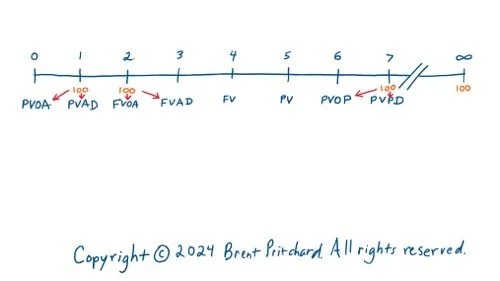
There are a few things to point out. First, note how the tip of the arrow resembles the letter V. This reminds us where the (Present or Future) Value is under the timeline in relation to the first or last payment for an annuity and the first payment for a perpetuity. The abbreviations are as follows:
Present Value of an Ordinary Annuity (PVOA);
Present Value of an Annuity Due (PVAD);
Future Value of an Ordinary Annuity (FVOA);
Future Value of an Annuity Due (FVAD);
Present Value of an Ordinary Perpetuity (PVOP);
Present Value of a Perpetuity Due (PVPD);
And last but not least, Future Value (FV) and Present Value (PV).
The Perfect Timeline requires that you have a certain level of comprehension with regard to the Building Block Time Value of Money equations and how a lump-sum or single payment is different from an even series, etc.
Assuming a 5% true investment yield, which is what some might call a compound interest rate, can you find the following values:
PVOA: 185.94 (euro)
PVAD: 195.24 (euro)
FVOA: 205 (euro)
FVAD: 215.25 (euro)
PVOP: 2,000 (euro)
PVPD: 2,100 (euro)
FV of the FVAD: 226.01 (euro)
PV of the PVPD: 1,904.76 (euro)
Now consider the following:
The timeline is silent with regard to the time span in between periods or payments. This was on purpose to illustrate a point. Does the space in between each time period marker represent one year, six months, a quarter, a month, a week? This is an important question, because you can’t compound or discount moneys below the timeline unless you have an “i” that matches “n.” Enter the last of the Building Block Time Value of Money equations: the True Investment Yield equation.
Notice how we could add a “1” to each time period marker and consider a different range of time.
If you’re running the numbers using the building block Time Value of Money equations for an annuity, pay attention to the relationship between “N” and “PMT.”
Did you catch that for the FVOA the second in the series of two even payments doesn’t earn a return on investment.
For those fluent with the building block Time Value of Money equations for an annuity or perpetuity, see how the add-on expression, (1 + i), just moves the PVOA and FVOA and PVOP one period into the future to calculate the PVAD and FVAD and PVPD, respectively. As it relates to the future value associated with the even series with two even payments that last payment gets its turn to earn a return on investment, and the other payment gets to “work” for one more period.
Notice how the PVOA is as of one period before the first even payment in the series.
See how FVAD can sub-in for PV in the Building Block Future Value equation. Sooner or later, the future becomes the present!
If you’re doing the work and putting in the reps, first I congratulate you for getting this far! Now, did you notice how for the PVPD or PVOP the value of the investment is maintained at $2,000. For the PVPD, do you understand that the 100 (euro) payment happens right way, thus reducing the amount of money invested from 2,100 to 2,000 (euro). And finally, for the PVOP, do you understand that the 2,000 (euro) investment earns a return on investment for one period before the first payment in the series is made.
Notice how the PV doesn’t need to be as of (t)o(day) or (n)o(w); i.e., time period marker zero on the timeline.
There you have it, The Perfect Timeline. I don’t think our illustrator is going to be worried about not hearing from us again! Forget about it!
What do you think?
Brent Pritchard is an author and college finance lecturer with over two decades of industry experience and cofounder of Boxholm Press, LLC, a family-owned-and-operated publishing company providing educational content, products, and services. He pioneers an innovative and approachable new way of learning and teaching the Time Value of Money as well as thought leadership in other business topics. His most recent book is Would Your Boomerang Return? You can contact him on his website here.
What Do You Fear More: Flying or Flying Blind With Money?
First-time visitors who have stumbled across this blog are in for a treat. This is the corner of the internet where Time Value of Money lessons are communicated with stories that relate to real-world situations.
Take today for example. “It’s not every day that one flies to London” was the sentence that I had planned to write before a delay left me typing this post at O’Hare at 12:58 AM. (What follows is what I had planned to share from my outpost, but it still works. And that’s good, because I’m tired. No coffee in sight!) Yesterday, when we were driving to the airport and in between thoughts of how much I’d miss my family and dogs, it occurred to me that the topic of the next blog post was a no-brainer. Such a trip deserves a storyline about flight.

Photo by Brent Pritchard.
Here’s an excerpt from my book Would Your Boomerang Return? What Birds, Hurdlers, and Boomerangs Can Teach Us About the Time Value of Money (2023):
Actually, the four forces of flight relate to the topic of the Time Value of Money. “Does it fly?” in the context of flight comes down to drag, thrust, weight, and lift. Drag refers to the force that pulls things backward. Thrust refers to the force that pushes things forward. Weight refers to the force that pulls things down. Lift refers to the force that pushes things up. In the context of the Time Value of Money, we can think about discounting as drag, compounding as thrust, the hurdle rate as weight, and NPV as lift. While there are four forces of flight, lift is the outward sign of flight. In the context of the Time Value of Money, a positive NPV is the signal that an investment opportunity will “fly.” A pilot’s preflight check can be likened to a finance professional needing to double-check his or her math.
What would it take to find insights and new in the “old,” and where might that train of thought take you?
Brent Pritchard is an author and college finance lecturer with over two decades of industry experience and cofounder of Boxholm Press, LLC, a family-owned-and-operated publishing company providing educational content, products, and services. He pioneers an innovative and approachable new way of learning and teaching the Time Value of Money as well as thought leadership in other business topics. His most recent book is Would Your Boomerang Return? You can contact him on his website here.
For Recent College Finance Graduates the End Is the Beginning.
I was planning on letting last week’s post season a bit before venturing back into part two of my thoughts on Beg. Mode. But it seemed fitting given that this is a time of transition for many. I’m referring of course to the graduation season. Congrats to the grads!
For those graduates going into a career in finance, can you name this calculator?
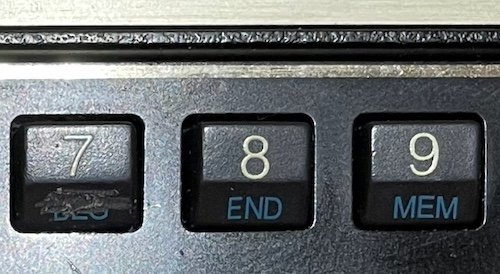
Photo by Brent Pritchard.
If not, and if your newest opportunity involves banking of any kind, that’s about to change. Notice the slight modification I made recently. Who knew about this alternative use for a paper clip?
Why would I want to do this (and deface my financial calculator by scraping away reference to Beg. Mode)? One word. Consistency. I like being able to tell you that for an annuity there’s a relationship between “N” and “PMT” as it relates to both inputs for the financial calculator and variables for the relevant building block Time Value of Money equation.
Here’s an excerpt from my book Would Your Boomerang Return? What Birds, Hurdlers, and Boomerangs Can Teach Us About the Time Value of Money (2023):
The end of one period is the same as the beginning of the next period. Imagine you’re bringing in the New Year in New York City. For a split second, when the ball drops and it starts raining confetti, the end is the beginning. On the timeline, period marker 1 represents the end of the first period and the beginning of the second period, and so on and so forth.
We can expand this thought and say that the beginning of the timeline, which is represented by period marker 0, also represents the end of a prior period. Nobody ever taught me this in school, but you can add “real estate” to the leftmost side of the timeline. That’s right: period marker -1.
Why would you want to do this (and add a period marker -1 to a timeline)? Because when you ignore Beg. Mode like I do, and when you’re running the numbers to solve for the present value of an (even) annuity, your financial calculator will be providing you with a value as of one period before the first payment is to be made. If you need the value as of period marker 0 then you’ll be using the FV key to get you the answer that you could double-check using the Building Block Present Value of an Annuity Due equation. This is what I call a “two-step” operation.
When I typed “The End” in the manuscript that would later become the book Would Your Boomerang Return? I made sure to also type “: The Beginning” on that last line. Will I write another book? My answer might surprise anyone who hasn’t had the opportunity to experience a creative, all-consuming project. It was a gift. And gifts are received. So, we’ll see. I don’t know at this time. But what I do know is that never in my wildest dreams would I have ever imagined that I’d be an author, a college finance lecturer, a husband to a great mom, a dad…. I’d never finish this post if completion of such a list were a prerequisite.
What surprises would you welcome before “The End” of your life, and since you’ve given your dream a name what are you waiting for?
Brent Pritchard is an author and college finance lecturer with over two decades of industry experience and cofounder of Boxholm Press, LLC, a family-owned-and-operated publishing company providing educational content, products, and services. He pioneers an innovative and approachable new way of learning and teaching the Time Value of Money as well as thought leadership in other business topics. His most recent book is Would Your Boomerang Return? You can contact him on his website here.
Get the Book Today!

Would Your Boomerang Return? provides a fun, new take on how the Mathematics of Finance is learned and taught:
All-in-one resource: all the important information on this all-important topic in one place with chapters in the What and How sections that double as individual lessons
Ease of reference: includes the first-of-its-kind user manual for the Mathematics of Finance with chapters named after sections typically found in an actual user manual for quick look up
Simple and definitive tool: 3-Step Systematic Approach for analyzing and evaluating real-world Time Value of Money situations
Decision-making framework: 23 real-world Time Value of Money questions, space to work out answers, and a "baseball count" system to evaluate understanding of the different types of questions
An easy read: complete with sprinklings of real-life stories and maybe even an ounce of inspiration here and there
Sign up for TVM 2$days, a weekly blog that offers a fun, new take on this age-old topic and financial education insights from Brent Pritchard.